
Periodic programmes
Commercial Carpet Cleaning Contracts in Sydney
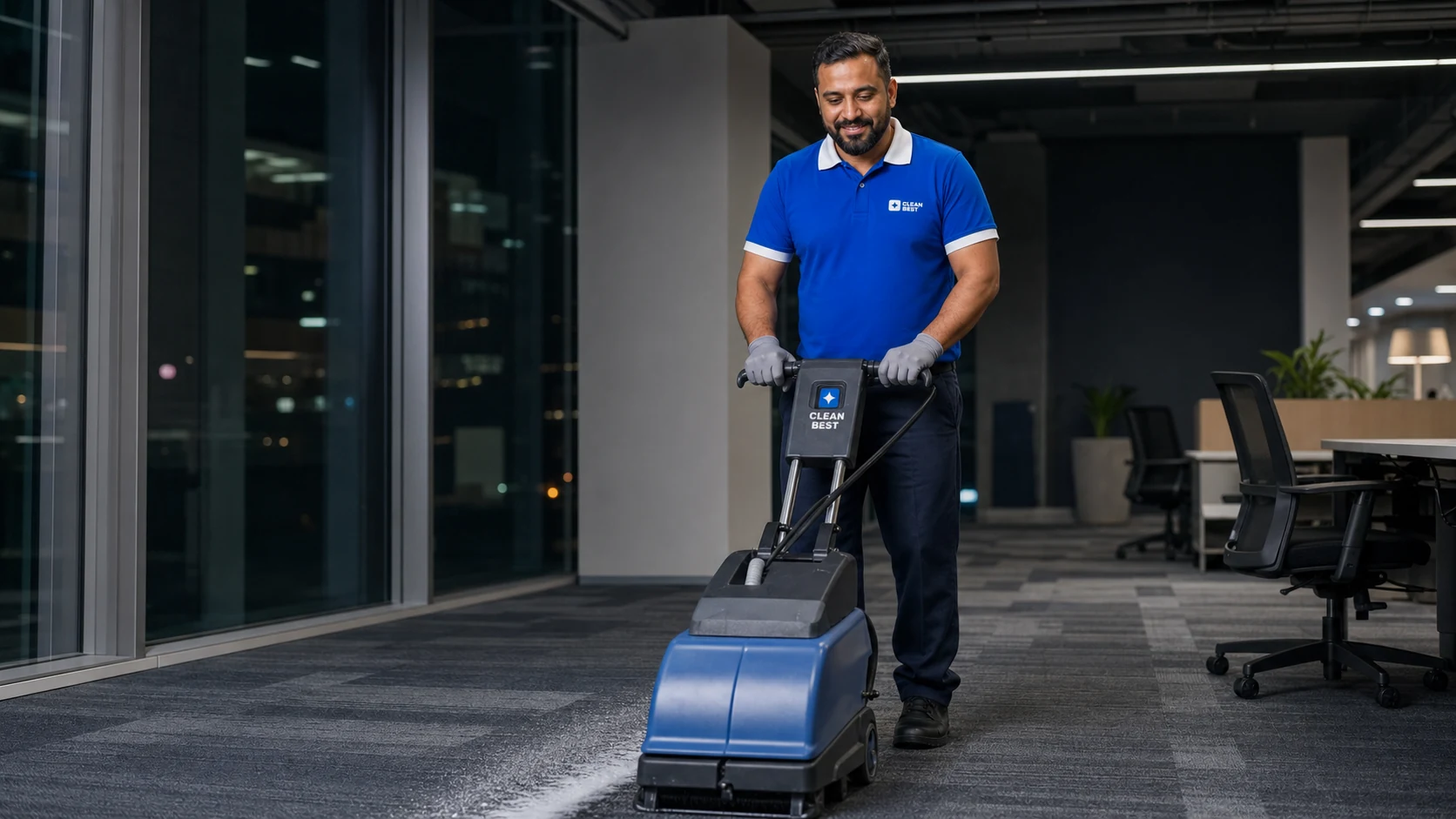
Commercial carpet cleaning across Sydney, contracted as a periodic programme rather than a panic. Hot-water extraction by zone with air movers behind the wand, a dry-time plan built around when the floor has to open, and an honest answer about which marks are never coming out.
- Zone sequence so no floor is fully out of service
- Dry before it opens — over-wetting is the whole problem
- Encapsulation on carpet tile between full extractions
- We tell you what will not come out before you pay
Engagement summary
- Roster window
- Weekends, by zone
- Insurance
- $20m public liability, certificate on file
- Turnaround
- Written submission inside 24 hours
- Agreement
- Rolling, 30 days notice either way
How is a commercial carpet cleaning contract scoped and scheduled?
Commercial carpet cleaning is the periodic deep cleaning of carpet in a workplace or building, distinct from the vacuuming performed as part of a recurring cleaning contract — and it should be scoped, priced and booked as its own programme rather than folded into a monthly figure, where it becomes invisible and stops being done.
The primary method is hot-water extraction: a pre-spray is applied and left to dwell, agitated where the soil load requires it, then flushed and extracted under pressure. Correct extraction — enough passes to remove the water that was put in — is what determines the result. Over-wetting drives soil into the carpet backing, from which it wicks back to the surface, which is why a poorly cleaned commercial carpet appears to grey out again within weeks. On carpet tile, encapsulation is often used between full extractions because it uses far less moisture and returns the floor to service faster.
Most Sydney office floors need traffic lanes and reception extracted around twice a year and the general floor plate annually. Clean Best quotes carpet cleaning after inspecting the carpet itself, in writing, within 24 hours on 02 5839 3012.
- Contract cleaning since 2015Holding scopes across Sydney since 2015
- Police-checked cleanersInducted for offices, warehouses, strata, clinics and campuses
- $20m public liabilityCertificate of currency supplied before the first shift
- Written submission inside 24 hoursScope, roster and fixed price, all in writing
The detail
A carpet cleaning contract Sydney floors can open the next morning
There are two ways to fail at a commercial carpet cleaning contract in Sydney, and almost every bad job is one of them. The first is leaving the carpet wet, so it is walked on damp, re-soils immediately and looks worse in six weeks than it did before anyone touched it. The second is telling the client a worn traffic lane will come clean, taking the money, and delivering a worn traffic lane.
Both are avoidable and both are about honesty as much as technique.
The water you put in is the water you have to take out
Extraction works because a pre-spray suspends the soil and pressurised water flushes it out. It fails when the operator puts more water in than they take out, which drives the soil down into the backing where it sits until it wicks back to the surface. That is the grey haze that appears five weeks after a cheap clean, and it is not bad luck — it is a predictable consequence of rushing the extraction passes to finish the job faster. We use the dwell time the chemistry needs and we pull the water back out, which takes longer and is the entire difference.
Dry time is the specification, not an afterthought
On a commercial floor, the only question that genuinely matters is when it can be walked on again. So we ask it first. Air movers run behind the wand rather than being set up at the end, the zone sequence is timed so the first area is dry before the last is wet, and the programme is scheduled against your access window. A floor that must be dry by six in the morning needs more equipment and more people than one with a whole weekend — that changes the price, and it should.
Carpet tile wants a different treatment
Most commercial tenancies are laid with solution-dyed nylon tiles on a bitumen or PVC backing. They take extraction well but will lift at the edges if they are saturated, and they respond very well to encapsulation — a low-moisture method that crystallises the soil for removal by the next vacuum. Used between full extractions, encapsulation holds the appearance level up and gets the floor back in service in a fraction of the time. We will tell you at the walk which method your floor actually wants rather than running the one we happen to have on the truck.
The marks that are not coming out
Permanent dye stains. Bleach damage. Sun fade. Delamination. And traffic lanes where the pile has been physically abraded — those look dirty because the fibre is destroyed, not because it is soiled, and no method in existence rebuilds them. We identify these at the walk and tell you before you have committed a cent. Occasionally that means talking ourselves out of a section of the job, which is fine: the alternative is taking the money and handing back a floor that looks exactly the same.
Odour at the surface, and odour in the underlay
Surface odour generally lifts with the soil. Odour that has reached the backing or the underlay — an unreported spill, an incident in a clinic or a childcare room — lives below the carpet, and extracting the carpet four times will not touch it. Sometimes the honest answer is that a section of underlay needs replacing, which is not a cleaning job at all. Knowing which of the two you have is worth more than the clean itself, and it costs nothing to find out at the walk.
Programme it, do not react to it
Carpet cleaning that happens because somebody finally noticed is always more expensive and always less effective than carpet cleaning that happens on an interval. We set an interval per zone — reception and traffic lanes short, the back of the floor plate long — book it ahead, and put it in your budget as a line item. Call 02 5839 3012 and we will look at the carpet.
Zone sequencing
The floor stays open, because we clean it in the right order
A whole floor cleaned at once is a floor nobody can use, which is why so much commercial carpet never gets extracted at all — the disruption is worse than the grey. So we do not clean whole floors at once. We divide the plate into zones, sequence them so the first is drying while the last is being wet, and run air movers behind the wand rather than parking them at the end.
The result is a floor that is fully usable the next working day, every time, and a programme that can actually be scheduled instead of being deferred year after year until the carpet has to be replaced. Deferral is the expensive option. It always was.
- Floor plate divided into zones with a timed sequence
- Air movers behind the wand, not parked at the end
- Traffic lanes and reception on a shorter interval than the plate
- Booked ahead as a programme, so it is never deferred
Scope of works
What sits in a carpet cleaning programme
The shape a typical Sydney commercial extraction takes. Yours is written from an inspection of the carpet itself, not from a floor plan.
- Inspect fibre, backing and soil load; identify wear, dye damage and anything that will not respond, and tell you before starting
- Move light furniture where agreed; heavy and fixed items are cleaned around and noted in the scope
- Vacuum thoroughly with a commercial machine before any moisture is applied — this removes most of the dry soil
- Pre-spray to the fibre type and soil load, with the dwell time the chemistry actually requires
- Agitate traffic lanes and heavily soiled areas rather than relying on the wand to do everything
- Treat identified spots and spills individually with the correct chemistry for the stain type
- Hot-water extract under pressure with enough passes to recover the water that was applied
- Run air movers behind the wand, zone by zone, so drying begins immediately rather than at the end
- Encapsulate carpet tile between full extractions where that is the better method for the floor
- Groom the pile where the carpet type benefits from it
- Sequence the zones so the first is dry before the last is wet, and the floor opens on time
- Report on what was achieved, what was not, and the interval we recommend for each zone
Outside our scope: carpet repair, re-stretching, patching, underlay replacement and re-lay. If the problem is under the carpet rather than in it, we will tell you at the inspection rather than extracting it four times.
Commercial terms
How commercial carpet cleaning gets priced
Three shapes of job. The dry-time window moves the figure more than the area does, because a floor that must open at 06:00 needs more equipment and more people than one with a whole weekend.
Single-zone clean
A reception, a boardroom, a corridor, or a tenancy small enough to do in one visit outside hours.
- Hot-water extraction with correct dwell and extraction
- Air movers running behind the wand
- Dry before the floor opens the next morning
- Honest assessment of what will not come out
Fixed figure, issued in writing before mobilisation.
Full-floor programme
An office floor plate, a childcare centre, a clinic or a gym cleaned zone by zone across a night or a weekend.
- Zone sequence timed so no area is out of service
- Traffic lanes and reception on a separate, shorter interval
- Encapsulation between extractions on carpet tile
- Scheduled as a periodic programme, budgeted up front
Fixed figure, issued in writing before mobilisation.
Portfolio programme
Multiple floors, buildings or sites under one facilities team, scheduled across the year rather than reactively.
- Interval set per zone, per building, and booked ahead
- Sequenced across the portfolio to fit your access windows
- One programme document covering every site
- Consolidated invoicing and a single point of contact
Fixed figure, issued in writing before mobilisation.
Free site walk, then a written scope and fixed price inside 24 hours.
Mobilisation
How a carpet programme gets booked
Four stages, and the first question is when the floor has to be usable again.
- Stage 1
Tell us the dry-time window
Call 02 5839 3012 with the area, the fibre if you know it, the access hours and — most importantly — the hour the floor must be usable again.
- Stage 2
We look at the carpet, not the floor plan
Fibre, backing, soil load, traffic lanes, existing damage. We tell you at the walk which marks are staying, before you have spent anything.
- Stage 3
Method, zone sequence and price
Within 24 hours: extraction or encapsulation, the zone order, the dry-time plan, and a fixed figure. Scheduled, not squeezed in.
- Stage 4
Clean, dry, and back in service
Air movers run behind the wand. The first zone is dry before the last one is wet, and the floor opens on time.
FAQ
Commercial carpet cleaning contracts: what facilities teams ask
The questions worth asking before a contractor puts water into your floor.
How long will the floor be out of action?
That is the only question that actually matters on a commercial floor, and the answer is: no zone is out of action for a working day. We clean by zone across a weekend or a night, with air movers running behind the wand, and we time the sequence so the first zone is dry before the last one is wet. A carpet that is walked on damp re-soils faster than one that was never cleaned, which is why a contractor who over-wets and leaves is worse than useless.
Why does the carpet look fine for a month and then go grey again?
Because it was over-wet and under-extracted, and the soil that was driven into the backing has wicked back to the surface. It is the single most common failure in commercial carpet cleaning and it is entirely avoidable: correct pre-spray, correct dwell time, correct extraction pressure, and enough passes to actually pull the water back out. A cheap clean that greys out in five weeks is more expensive than a proper one that holds for a year.
Can you clean carpet tiles as well as broadloom?
Yes, and they need a different approach. Carpet tiles in a commercial tenancy are usually solution-dyed nylon on a bitumen or PVC backing, which tolerates extraction well but will lift at the edges if it is saturated. Encapsulation is often the better method on tiles between full extractions — lower moisture, faster return to service, and it holds the appearance level up between the deep cleans. We will tell you at the walk which method your floor actually wants.
What can you not get out?
Permanent dye stains, bleach damage, sun fade, delamination and traffic-lane wear where the pile has been physically abraded away. We will tell you before we start rather than after we have taken your money — a worn traffic lane looks dirty because the fibre is damaged, not because it is soiled, and no amount of extraction rebuilds it. What we can do is lift the soil, remove most spills and odours, and honestly tell you which marks are staying.
Do you deal with odour, or just appearance?
Both, but they are different jobs. Surface odour usually lifts with the soil. Odour that has reached the backing or the underlay — a spill nobody reported, an incident in a childcare centre or a clinic — needs treatment at the source, and sometimes it needs the underlay replaced, which is not a cleaning job. We will identify which of the two you have during the walk, because paying for extraction on a problem that lives in the underlay is money set on fire.
How often should commercial carpet be extracted?
For most Sydney office floors, twice a year for the traffic lanes and reception, and annually for the general floor plate — with regular vacuuming in between doing most of the real work. Childcare centres, clinics and gyms need it more often. A high-traffic reception may need quarterly attention on its own. We recommend an interval per zone rather than one interval for the tenancy, because reception and the back corner of the floor plate are not the same carpet.
How is a commercial carpet cleaning contract priced in Sydney?
It is not published here. Extraction is priced on area, soil load, fibre type, access and the dry-time window you need — and that last one moves the number more than anything else, because a floor that must be dry by 06:00 requires more air movers and more people than one with a whole weekend. We walk it, look at the carpet rather than the floor plan, and quote in writing within 24 hours.
Related scopes
Scopes commonly programmed alongside carpet
Periodic work scheduled up front, so none of it arrives as a variation.
Programme a carpet cleaning contract your floors can open on top of the next morning
We inspect the carpet, tell you what will not come out, and build the zone sequence backwards from your dry-time window. Call 02 5839 3012.