
Regulated sites
Medical Centre Cleaning Contracts in Sydney
Infection-control cleaning contracts for Sydney medical centres, dental practices and allied health clinics. A colour-coded method, hospital-grade disinfectants used with the contact time the label specifies, and a signed register a surveyor can read without you editing it first.
- Colour-coded equipment, zone by zone, no exceptions
- Disinfectant contact times observed, not assumed
- Signed cleaning register kept on site for accreditation
- Clinical waste left to your licensed contractor
Engagement summary
- Roster window
- After last appointment
- Insurance
- $20m public liability, certificate on file
- Turnaround
- Written submission inside 24 hours
- Agreement
- Rolling, 30 days notice either way
What should a medical centre cleaning contract require of a contractor?
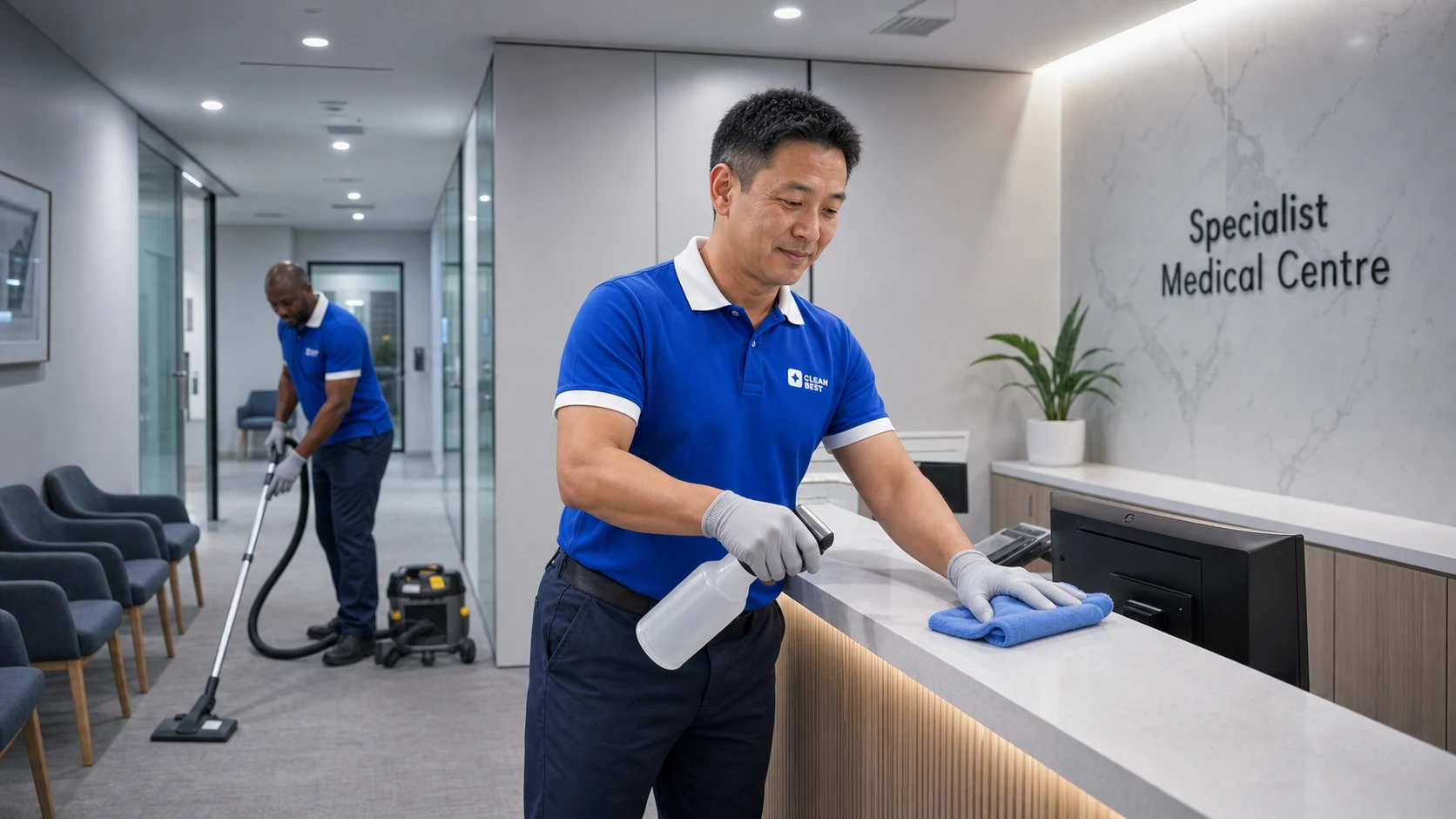
A medical centre cleaning contract engages a contractor to clean and disinfect a healthcare premises to a documented infection-control method, covering consult and treatment rooms, the sterilising bay, reception and waiting areas, washrooms and staff areas. The contract should specify the method, not just the rooms — and it should name the record the practice will hold, because in an accredited practice the record is part of the deliverable.
It differs from general commercial cleaning in three specific ways. Equipment is colour-coded by zone so cloths and mops never travel between a washroom and a treatment surface. Disinfectants are hospital-grade and must remain wet on the surface for the contact time stated on the label. And each visit is signed into a cleaning register, because in an accredited practice the documented record is part of the deliverable, not an optional extra.
Clinical waste and sharps remain the responsibility of the practice’s licensed clinical waste contractor. Clean Best prices medical centre cleaning after attending the clinic following its last appointment, and issues the scope, the method and a fixed figure in writing within 24 hours on 02 5839 3012.
A medical cleaning contractor Sydney practice appoints should also state the boundaries around sharps, clinical waste, instruments and contaminated incidents, with exceptions escalated to the practice.
- Contract cleaning since 2015Holding scopes across Sydney since 2015
- Police-checked cleanersInducted for offices, warehouses, strata, clinics and campuses
- $20m public liabilityCertificate of currency supplied before the first shift
- Written submission inside 24 hoursScope, roster and fixed price, all in writing
The detail
A medical centre cleaning contract practices can hand to a surveyor
On a commercial floor, a cleaning failure is an inconvenience. In a clinic it is a clinical risk and an accreditation finding, which is why what a practice buys under a medical centre cleaning contract in Sydney is not really cleaning at all. It is a documented method, performed consistently, with a record you can produce. The surfaces are almost the easy part.
Most practices discover this the hard way, usually about a fortnight before a survey.
The colour code is not a nice-to-have
One cloth, moved from a washroom to a treatment bench, undoes the entire clean — and no hospital-grade chemical anywhere on the invoice will rescue it. So equipment is colour-coded by zone: one colour for consult and treatment rooms, one for washrooms, one for kitchen and staff areas, one for general floors. Cloths and mop heads do not cross zones, they are laundered rather than rinsed, and the operator is inducted on the system before their first shift rather than being handed a bucket and told to be careful.
Contact time is where disinfection actually happens
A surface wiped with disinfectant and dried four seconds later has been cleaned, not disinfected. Every hospital-grade product states a contact time on the label — the period the surface must remain wet for the claim to hold — and observing it is the difference between infection control and theatre. Our operators are trained to it, every product is on a chemical register with its safety data sheet, and if your practice has a preferred product we will use it unless it is wrong for the surface, in which case we will say so before we damage a bench.
The register is the deliverable
When a surveyor asks how the treatment rooms are cleaned, they do not want reassurance. They want a dated document. Each visit is signed against the areas and tasks in the scope, and the register lives on site, in the practice’s hands, not in ours. It is written to be handed over unedited. If your accreditation program expects a particular format, tell us at the site walk and we will produce it in that shape from day one rather than reconstructing fourteen months of history the week before the survey.
Where we stop: clinical waste and sharps
Our operators do not open, move, decant or dispose of clinical waste, and they do not touch sharps containers. That stream belongs to your licensed clinical waste contractor and its regulated chain of custody, and any cleaner who offers to help with it is handing you a serious problem in exchange for a small convenience. What we do is clean around the containers and their bases, and tell you immediately if one is overfull or if general waste has ended up in a clinical stream.
Privacy, and the fact that patients are people
A clinic clean starts after the last appointment, which in practice can mean 20:30 on an evening the last patient ran late. Operators are inducted on privacy before their first shift: what they may not touch, where they may not go, what to do if somebody is still in a room, and the fact that anything they see or hear stays inside the building. Where a practice needs a mid-day pass for reception, washrooms and high-touch surfaces during a busy clinic, that is scoped as its own band rather than being smuggled into the evening.
What it costs to find out
A walk of the clinic after the last appointment. A room-by-room method, the colour-coding, the chemical register and a fixed monthly figure back in writing within 24 hours, with the register format agreed before we start. A rolling agreement on 30 days notice. Call 02 5839 3012.
Dental, allied health and specialists
Different rooms, different risk, different method
A dental surgery is not a GP consult room and neither is a physiotherapy plinth. The aerosol load, the surface materials and the equipment you must never spray directly are all different, and a contractor running one method across all of them will eventually damage something expensive or miss something important. The scope is written room type by room type, and the operator is inducted on each.
The sterilising bay gets particular attention, because it is the one room where a cleaning error is most likely to matter clinically. We clean the room and its surfaces to the method, and we do not touch the instruments, the autoclave load or anything inside the sterilisation chain. That line is written into the scope so that nobody has to make a judgement call at nine at night.
- Method written per room type, not one method for the clinic
- Sterilising bay cleaned to a defined boundary, instruments untouched
- Equipment never sprayed directly where the surface forbids it
- Operators inducted on each room type before the first shift
Scope of works
What sits in a medical centre cleaning scope
The shape a typical Sydney clinic scope takes. Yours is written room type by room type from a walk conducted after the last appointment.
- Consult and treatment rooms: benches, basins, taps, examination couch, chair arms and all high-touch surfaces disinfected to contact time
- Treatment room floors mopped with zone-coded equipment, corners and under-bench areas included
- Sterilising bay: bench surfaces, sink, floor and bin base cleaned to the defined boundary; instruments and autoclave load untouched
- Clinical bin bases and surrounds cleaned; containers themselves left to your licensed waste contractor
- Reception and waiting area: counter, screen, EFTPOS terminal, chairs, arms, toys where present, magazines rack and door handles
- Patient washrooms: pans, basins, taps, mirrors, baby change surfaces, rails; restock paper, soap and hand towel
- Staff kitchen and amenities: benchtops, sink, fridge exterior, microwave interior, table and chairs
- Vacuum all carpeted areas including under waiting-room seating and along skirtings
- Mop all hard floors with zone-coded mop heads, working away from the exit
- Disinfect touchpoints throughout: door handles, light switches, taps, rails, keyboards and phones at reception
- Entry glass and internal glass within reach, fingerprints removed
- Sign the cleaning register for the visit, against the areas and tasks in the scope
Outside this scope: clinical and related waste, sharps containers, instrument reprocessing, anything inside the sterilisation chain, and any surface a manufacturer forbids us to treat. Those boundaries are written into the scope so nobody has to improvise at nine at night.
Commercial terms
How a medical centre cleaning contract gets priced
Three bands by the shape of the practice. The figure comes from a walk after the last appointment — a four-room GP clinic and a twelve-chair dental practice are different jobs at the same floor area.
Small practice
A GP or allied health practice with up to roughly four consult rooms, a reception, a staff kitchen and a patient washroom.
- Rostered after the last appointment
- Colour-coded method across all zones
- Hospital-grade disinfectant with the label's contact time
- Signed cleaning register kept on site
Fixed figure, issued in writing before mobilisation.
Multi-room clinic
A larger medical centre or dental practice with treatment rooms, a sterilising bay, multiple washrooms and a busy waiting area.
- Nightly roster with a documented room-by-room method
- Sterilising bay and clinical bin bases in the recurring band
- Named supervisor with a monthly audit against the scope
- Register written to be handed to a surveyor unedited
Fixed figure, issued in writing before mobilisation.
Health precinct
A medical centre with co-located specialists, imaging or pathology, or a group holding several practices under one manager.
- Separate scope per tenancy, one supervisor across the precinct
- Optional mid-day pass for reception and high-touch surfaces
- Periodic floor and carpet programmes scheduled by room
- One register format across every practice in the group
Fixed figure, issued in writing before mobilisation.
Free site walk, then a written scope and fixed price inside 24 hours.
Mobilisation
How a clinic changes cleaning contractor
Four stages, and the site walk happens after the last patient has gone.
- Stage 1
Tell us how the practice runs
Call 02 5839 3012 with the room count, the last appointment time, your accreditation program and any product you already use.
- Stage 2
We attend after the last patient
So we see the clinic the way our operator will, and so nobody walks a stranger through a waiting room while patients are still in it.
- Stage 3
Scope, method and register
Within 24 hours: the room-by-room method, the colour-coding, the chemical register, the fixed figure and the register format you will hold.
- Stage 4
Induct on privacy, then start
The operator is briefed on privacy, on what they may not touch, and on your clinical waste boundaries before their first shift.
FAQ
Medical centre cleaning contracts: what practices ask
The questions a practice manager asks before letting a contractor into a treatment room.
What is a colour-coded cleaning method, and why does a practice need one?
It is the discipline of assigning a colour of cloth and mop to each zone — one for consult and treatment rooms, one for washrooms, one for kitchen and staff areas, one for general floors — so equipment never travels from a toilet to a treatment bench. It sounds trivial and it is the foundation of infection control in a clinic. Without it, a single cloth can undo an entire clean, and no amount of hospital-grade chemical will save you.
Can you produce a cleaning record for our accreditation?
That is the deliverable, as much as the cleaning is. Each visit is signed against the areas and tasks in the scope, so the practice holds a dated register showing what was cleaned and disinfected and when. Surveyors do not want reassurance, they want a document. Ours is written to be handed over without editing, and if your accreditation program has a particular format, tell us at the site walk and we will produce it in that shape.
Who handles clinical waste and sharps?
Not us, and be careful of any cleaner who says otherwise. Clinical and related waste, including sharps containers, is handled by your licensed clinical waste contractor under its own regulated chain. Our operators do not open, move, decant or dispose of clinical waste streams. We clean around them, we clean the bin bases and the room, and we tell you immediately if a container is overfull or a stream has been contaminated with general waste.
What disinfectants do you use in consult and treatment rooms?
Hospital-grade disinfectants applied with the contact time the label specifies, which is the part almost everybody gets wrong — a surface wiped and dried in four seconds has been cleaned, not disinfected. Every product on site is on a chemical register with its safety data sheet. If your practice has a preferred product or a supplier arrangement, we will use it. If it is not fit for the surface, we will tell you before we start rather than damage a treatment bench.
When do you clean a practice that runs until eight in the evening?
After the last appointment, and it is worth being honest that this can mean starting at 20:30. Allied health rooms, dental practices and after-hours GP clinics all run late, and a clean that starts before the last patient has left is a privacy problem as well as an infection-control one. Where a practice needs a mid-day pass — reception, washrooms, high-touch surfaces during a busy clinic — that gets scoped as a separate band rather than squeezed into the evening.
Are your operators cleared to work in a healthcare setting?
Every operator is police-checked before their first shift and inducted on the specific requirements of your practice: privacy, what they may and may not touch, where they may not go, how to behave if a patient is still present. Where the practice sees children, a Working with Children Check is held as well. If your practice requires immunisation evidence for contractors, tell us and we will confirm what we can and cannot provide before you appoint us.
How is a medical centre cleaning contract priced in Sydney?
No figure will appear on this page. A four-room GP clinic and a twelve-chair dental practice have entirely different infection-control loads even at similar floor areas, and the honest answer is that we cannot know before we have walked it. We attend after the last appointment, count the rooms, the amenities and the surfaces, and return a fixed monthly figure in writing within 24 hours.
Related scopes
Scopes health sites commonly hold alongside the clinic
Same supervisor, same register discipline, one invoice.
Sign a medical centre cleaning contract surveyors do not query
We walk the clinic after the last appointment and return the method, the register format and a fixed figure within 24 hours. Call 02 5839 3012.