
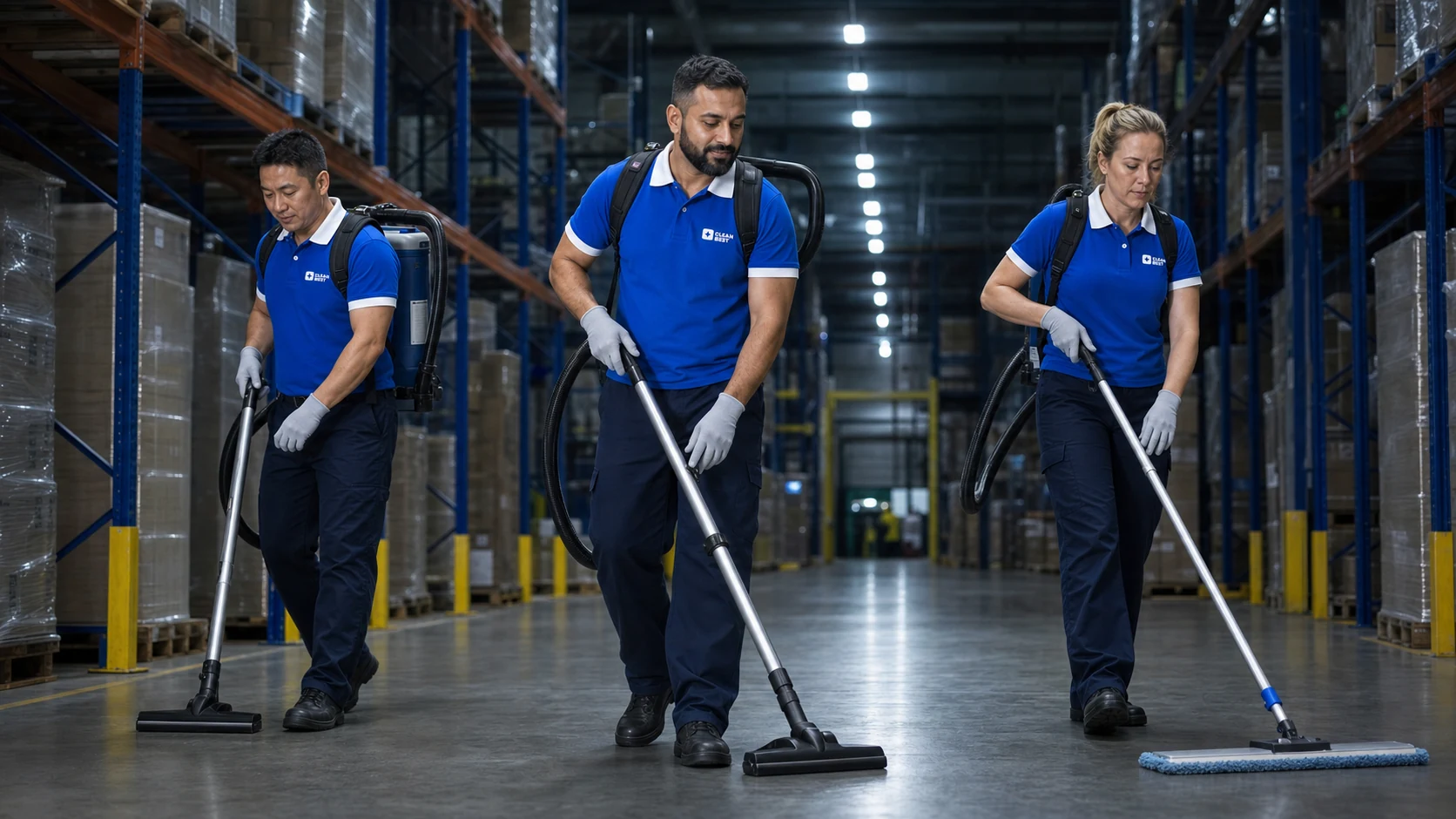
Industrial and distribution
Warehouse Cleaning Contractors in NSW
A contract cleaning contractor for NSW warehouses, distribution centres and industrial facilities. Ride-on scrubbing under a task-specific SWMS, racking dusting on a documented zone rotation, and a roster built into your shift changeovers rather than imposed on them.
- Rostered into changeovers on sites that never close
- Task-specific SWMS for every machine activity
- Racking and high-level dusting on a zone rotation
- Dock, apron, crib room and amenities in the same scope
Engagement summary
- Roster window
- Between shifts or weekends
- Insurance
- $20m public liability, certificate on file
- Turnaround
- Written submission inside 24 hours
- Agreement
- Rolling, 30 days notice either way
What should a warehouse cleaning contractor supply before working on an NSW site?
A warehouse cleaning contractor is engaged under a standing contract to clean an industrial facility: machine scrubbing or sweeping of the floor, dusting of racking and high-level surfaces, cleaning of loading docks and aprons, and cleaning of the amenities, crib rooms and office cells attached to the site. Before an operator enters the site, the contractor is normally expected to supply a task-specific safe work method statement for every activity in the scope, a chemical register with safety data sheets, certificates of currency for public liability and workers compensation, and police check confirmations — and to have cleared the site’s contractor management system or inductions portal.
It differs from office cleaning in two ways that matter. The work is scheduled around operating shifts rather than after hours, because most distribution facilities do not fully close. And it carries a work health and safety obligation: machine operation, wet floors near forklift routes and any work at height must sit under a task-specific safe work method statement and be coordinated with the site’s traffic management.
Clean Best prices warehouse cleaning after a site walk conducted during an operating shift, and issues the scope, the SWMS and a fixed monthly figure in writing within 24 hours on 02 5839 3012.
A warehouse cleaning contractor Sydney buyer can assess on this basis should state machine zones, traffic controls, dock responsibilities, high-level rotations and the evidence required before mobilisation.
- Contract cleaning since 2015Holding scopes across Sydney since 2015
- Police-checked cleanersInducted for offices, warehouses, strata, clinics and campuses
- $20m public liabilityCertificate of currency supplied before the first shift
- Written submission inside 24 hoursScope, roster and fixed price, all in writing
The detail
A warehouse cleaning contractor an NSW site can run a shift through
What a site actually needs from a warehouse cleaning contractor in NSW is not a bigger machine. It is a plan that survives contact with a site that never stops. Almost every industrial cleaning contract that fails in this state fails the same way: it was written as if the building would be empty, the building was never empty, and within two months the contractor was either running a scrubber down a live aisle or simply not doing the work.
We build the roster from the shift pattern. Everything else follows.
There is no after-hours window, only gaps
A three-shift distribution centre has no dead hours. What it has is gaps: twenty minutes when the pick face goes quiet, an hour after the outbound run has left and before the inbound lands, a slower Sunday. That is where the work goes. Heavier machine passes and racking rotations move to the weekend where they belong. It is less convenient for us and considerably safer for you, and it is the only version of this that holds up past month three.
Machine work under a SWMS, not under a hope
A ride-on scrubber in a forklift aisle is a serious event waiting for a date. So machine activity sits under a task-specific safe work method statement, the operator works a defined and signed zone rather than wandering, and the zone is coordinated with your traffic management rather than layered on top of it. Where a zone cannot be isolated safely, we do not run the machine there — and we tell you that at the site walk instead of discovering it at eleven at night with a shift running late.
Racking dust is a fire load, and it is cleaned on a rotation
Dust on racking is not cosmetic. It becomes a fire-load conversation with your insurer, and on food-adjacent sites it becomes a contamination conversation with your auditor. Cleaning all of it at once means a shutdown nobody will approve, so it does not get done at all. We divide the racking into zones and cycle through them to a documented interval, which means every bay has a date against it and the site is never fully out of service. When the insurer asks, you have a rotation record rather than one annual invoice and a story.
The dock is where a visiting auditor forms their opinion
It is the dirtiest interface on the site, the first thing anyone sees, and the surface most likely to put a person on their back. It gets cleaned clear of traffic, degreased where the scope calls for it, and the apron gets swept. The crib room, the amenities and the office cell go on the same recurring bands as any commercial contract, because that is where your people take their breaks — and a site that treats the crib room as an afterthought tells its workforce exactly what it thinks of them.
Clearing your contractor management system before we mobilise
Most industrial sites run an inductions portal or a contractor management system, and most cleaning contractors treat it as a surprise discovered a week before start. Send us the link with the brief. We will be through it, with SWMS and certificates uploaded, before we attend the site walk. It is unglamorous and it is the single most common reason a mobilisation date slips.
Where the rest of the Clean Best network sits
Clean Best also runs a brand hub covering the same trades for a general audience, and it publishes its own view of warehouse cleaning across NSW if you want the service described without the procurement framing this page is written in. Same operators, same insurance, different reader.
What it costs to find out
A site walk during an operating shift, because an empty warehouse tells you nothing worth knowing. A written scope with zone rotations, a task-specific SWMS for every machine activity, and a fixed monthly figure, all back inside 24 hours. A rolling agreement on 30 days notice. Call 02 5839 3012.
Work health and safety
The wet floor is the hazard, and the plan is the deliverable
On an office floor a wet-floor sign is a courtesy. On an industrial floor with an active forklift route it is the difference between a controlled task and a serious incident report. Our operators work a drying sequence that keeps a walkway open, they cone and sign the zone before the machine starts rather than after, and they do not improvise around a hazard because the shift is running late — which is precisely when improvisation happens.
Every chemical brought onto your site is on a register with a safety data sheet against it, and every task we perform has a SWMS you can read before you sign anything. If your WHS manager wants to walk the first shift with our supervisor, that is welcome rather than merely tolerated. It is the fastest way for both sides to find out whether the plan on paper survives the actual building.
- Zones coned and signed before the machine starts
- Drying sequence that keeps a walkway open
- Chemical register with an SDS for every product on site
- Your WHS manager welcome to walk the first shift
Scope of works
What sits in a warehouse cleaning scope
The shape a typical Sydney distribution scope takes. Yours is written from a walk conducted mid-shift, so the zones and bands will be specific to your traffic.
- Machine scrub or sweep main aisles and cross-aisles within coned, signed zones under a task-specific SWMS
- Sweep and scrub the pick face on the frequency your throughput demands
- Racking and beam dusting on a documented zone rotation, with an interval recorded against each bay
- High-level dusting of structure, ducting and light fittings on rotation, called out separately where an EWP is required
- Clean the loading dock, dock levellers and door tracks clear of traffic
- Sweep and degrease the apron and the immediate yard where the scope calls for it
- Crib room: benchtops, sinks, fridge exteriors, microwave interiors, tables and chairs, waste and recycling
- Amenities: pans, urinals, basins, mirrors, showers where present; restock paper, soap and hand towel to the agreed level
- Office cell and dispatch desk: waste, floors, touchpoints, entry glass
- Disinfect shared touchpoints: door handles, RF scanners' charging bays, time clocks, rails and switches
- Spot-clean spills and product damage on request, logged against the shift
- Report at sign-out anything that could not be completed and why, so it lands in the monthly audit
Outside this scope by design: work at height requiring an EWP licence, confined-space entry, hazardous-material remediation, and any accredited food-safety cleaning we do not hold the qualification for. We will identify these at the site walk and tell you which specialist you need.
Commercial terms
How a warehouse cleaning contract gets priced
Three bands by the shape of the facility. The figure comes from the mid-shift walk and is issued in writing before mobilisation — no rate card, because industrial sites vary more than any other asset class we clean.
Single-shift facility
One operating shift, a modest dock, a crib room and an office cell. Bulk storage rather than a busy pick face.
- Roster after the shift ends, or before it starts
- Amenities, crib room and office cell on recurring bands
- Walk-behind scrubbing of main aisles and the dock apron
- Racking dusting on a documented zone rotation
Fixed figure, issued in writing before mobilisation.
Multi-shift distribution centre
Two or three shifts, a high-throughput pick face, several dock doors and an amenities block used around the clock.
- Roster built into your shift changeovers, not around them
- Ride-on scrubbing under a task-specific SWMS
- Dock and apron cleaned clear of traffic routes
- Named supervisor with a monthly audit against the scope
Fixed figure, issued in writing before mobilisation.
Industrial campus
Multiple buildings, a yard, workshop or production areas, and a contractor management system to clear before you start.
- Dedicated crew inducted through your contractor portal
- Machine programmes and periodic works scheduled by zone
- Chemical register and SWMS maintained per building
- One site register, one supervisor, one consolidated invoice
Fixed figure, issued in writing before mobilisation.
Free site walk, then a written scope and fixed price inside 24 hours.
Mobilisation
How we mobilise on an industrial site
Four stages, and the contractor management system is cleared before the site walk rather than after.
- Stage 1
Send the shift pattern
Call 02 5839 3012 with the floor area, shift times, dock count, traffic management rules and whichever contractor portal we need to clear.
- Stage 2
We walk it mid-shift
An empty warehouse tells you nothing. We attend while it is operating so we can see the traffic, the dust, the dock and where a machine can and cannot go.
- Stage 3
Scope, SWMS and fixed price
Within 24 hours: the scope with zone rotations, the task-specific SWMS for every machine activity, and the fixed monthly figure.
- Stage 4
Induct through your system, then mobilise
Operators clear your contractor management system and site induction before the first shift. The supervisor audits at the end of month one.
FAQ
Warehouse cleaning contractors: what site managers ask
The questions that come up when an industrial site puts its cleaning out.
When do you clean a warehouse that runs three shifts?
In the changeover, and at the weekend. A site running around the clock does not have an after-hours window, it has gaps — twenty minutes when the pick face is quiet, an hour when the outbound run has left and the inbound has not landed. We build the roster from your shift pattern rather than asking you to bend it around ours. Heavier machine work and racking rotations move to the weekend, where they belong.
Is ride-on scrubbing safe to run while forklifts are operating?
Only with a plan, which is why we write one. Machine work sits under a task-specific SWMS, the operator works a defined zone rather than wandering the floor, the zone is signed and coned, and it is coordinated with your traffic management rather than layered on top of it. Where a zone cannot be isolated safely, we do not run the machine there and we say so — the alternative is putting a scrubber in a forklift aisle and hoping.
How is racking and high-level dusting handled?
On a zone rotation, not in one annual heroic pass. Racking accumulates dust that eventually becomes a fire load and a product-contamination risk, and cleaning all of it at once means a shutdown nobody can afford. We divide the racking into zones and cycle through them, so each zone is cleaned to a documented interval and the site is never fully out of service. Anything at height that requires an EWP or a licensed trade is called out at the site walk rather than improvised.
Do you clean the dock, the yard and the amenities as well as the floor?
Yes, and the dock is usually where the value is. It is the dirtiest interface on the site, it is what a visiting auditor sees first, and it is the surface most likely to put someone on their back. We clean the dock clear of traffic, degrease where the scope calls for it, sweep the apron, and put the crib room, the amenities and the office cell on the same recurring bands as any commercial contract — because that is where your people actually spend their breaks.
What compliance documents do you provide for an industrial site?
Task-specific SWMS for every activity we perform, a chemical register with safety data sheets for every product brought on site, certificates of currency for $20 million public liability and workers compensation, and police check confirmations for every operator. If your site runs an inductions portal or a contractor management system, send us the link and we will be through it before we attend, rather than holding up your mobilisation date.
Can you handle food-grade or contamination-sensitive areas?
We can clean to a documented method in food-adjacent and contamination-sensitive spaces, with colour-coded equipment, an approved chemical list and a signed record of each clean. What we will not do is claim a food-safety accreditation we do not hold. If your site sits under an audited food-safety program, tell us which one at the site walk and we will tell you plainly which parts of your scope we can sign and which need a specialist.
How does a warehouse cleaning contractor price an NSW site?
There is no figure on this page. Industrial sites vary more than any other asset class we clean — a 3,000 square metre pick face with a busy dock and two shifts and a 3,000 square metre bulk store touched twice a week are not the same job in any sense. We walk the site during an operating shift, count what actually drives the work, and issue a fixed monthly figure in writing within 24 hours.
Related scopes
Scopes industrial sites commonly hold alongside the floor
One supervisor, one audit, one invoice across the whole site.
Appoint a warehouse cleaning contractor an NSW site can run a shift through
Site walk mid-shift, scope and SWMS in 24 hours, contractor portal cleared before we mobilise. Call 02 5839 3012.